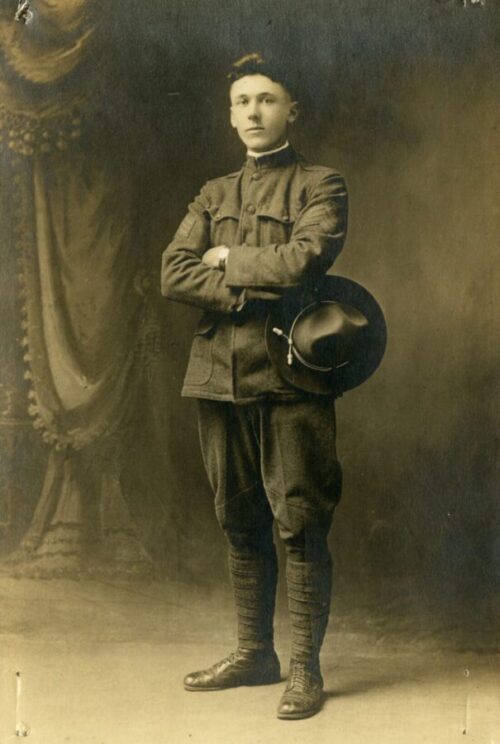
Erwin Louis Dann was born on 16 March 1896 in Burksville, Monroe County, Illinois. He was the son of Edward and Caroline (nee Kolter) Dann. After his father passed away in 1897, his mother remarried William Lohkamp in 1900. They all resided in Waterloo, Monroe County, Illinois with his older brother and younger sister. Dann enlisted into Company F, 1st Missouri National Guard on 19 June 1916 in St. Louis, Missouri. He was 5’ 7”, had black hair, brown eyes, fair complexion, weighed 148 pounds, was a skilled machinist, single, and resided at 3535 Pine Street, St. Louis, Missouri.
With the National Defense Act of 1916 enacted on 03 June 1916, the 1st Missouri Infantry was inducted into Federal Service on 25 June 1916 and was the first regiment to reach Camp Clark, Nevada, Vernon County, Missouri. From there they departed to Laredo, Webb County, Texas on 01 July 1916 for the Mexican Punitive Expedition. Dann and his unit remained in Texas until 02 September 1916, returned to Camp Clark and mustered out of federal service on 25 September 1916. Though they didn’t see any fighting, there were a few close calls. From those experiences on the Mexican border, they applied the lessons to their upcoming training and the eventual fighting in France.
On 26 March 1917, the 1st Missouri Infantry was once again mobilized in St. Louis and sent to Camp Clark. On 02 April 1917, Private Dann was appointed to Corporal. Four days later, the United States officially entered the World War on 06 April 1917. In July, the 1st Missouri Infantry was sent to Camp Maxwell, St. Louis County, Missouri to finish mobilization and begin basic training. While at Camp Maxwell, CPL Dann married Ms. Violet Jordan on 17 July 1917 in St. Charles County, Missouri. With a brief honeymoon, CPL Dann and the 1st Missouri were then sent to Camp Doniphan, Lawton, Comanche County, Oklahoma and drafted into federal service 05 August 1917.
To prepare National Guard units for deployment to Europe, the U.S. Army had to turn them into “regular” regiments, brigades, and eventually into a permanent division. These new division were not the same “temporary” divisions from the Civil War or the Spanish American War. These divisions would need to become self-sustaining fighting units. So, disbanding a state unit and combining several other state’s units by reorganizing them within a geographical region gave the new service members a recognition of home to fight for overseas. As an example, the 35th Division (made up of Missouri and Kansas soldiers) was originally the 14th Division under the Militia Bureau. On 18 July 1917, the War Department began to reorganize the division, drafted them into federal service on 05 August 1917 and redesignated them the 35th.
While conducting training at Camp Doniphan, the 1st Missouri Infantry and the 5th Missouri Infantry (minus the Band) consolidated and was designated as the 138th Infantry Regiment. The 138th was assigned to the 69th Infantry Brigade of the 35th Division on 01 October 1917. With several months of training and re-training after gaining recruits from Kansas and Missouri, plus draftees from surrounding training camps, the 35th Division was ready to deploy. Prior to movement Corporal Dann was appointed Sergeant on 16 March 1918. On 07 May 1918 from Philadelphia, Pennsylvania, SGT Dann sailed on the S/S Rhesus to England. After being at sea for over two weeks (17 days) the 138th arrived in London, England. On 26 May they sailed from Southampton and arrived at Le Harve, France on the 27th. The Prairie Division is now part of the American Expeditionary Forces (AEF).
When a new American division arrives to France it either gets dissolved into replacements to other American divisions, splits up into smaller units for rear echelon duty or enrolled for more training with the French and British and put into the line. The 35th Division was sent for more training. From the time they arrived until 11 September, they trained with various units in a multitude of defense sectors. On 12 September 1918, was their first major action. The Battle of St. Mihiel. Although they didn’t see any fighting, they were held in reserve at First U.S. Army level along with three other division.
The next battle that SGT Dann would participate in would unfortunately be his last. The Meuse-Argonne Offensive. On the morning of 26 September 1918, the 138th Infantry had the objective to reach and take the French village of Cheppy. The 138th Infantry also had the honors of leading off the attack for the entire 69th Infantry Brigade with tank support from LTC George S. Patton, Jr’s tank brigade. After dealing with thick morning fog, intense enemy artillery, interlocking enemy machine nests built of concrete and steel, miscommunication from the Regiment on down, and the loss of several key ranking officers, the 138th Infantry achieved the objective late that night. The cost was severe. The 69th Infantry Brigade was down to 50% of the 8,000 men it started with that morning. The rest of the division shared the same ratio. Sergeant Erwin Louis Dann was among those that were killed in the Battle of Cheppy. The division continued fighting up to 11 November 1918. The Meuse-Argonne Offensive still remains the largest military offensive maneuver in U.S. history involving 1.2 million American service members.
Having assembled with “SGT Erwin L. Dann” as their namesake for the VFW Post 805 in Waterloo, Illinois on 25 July 1921, the post sponsored the repatriation of his remains. SGT Dann was placed on the U.S.A.T. Cantigny on 03 February 1922 at Antwerp, Belgium. They docked at Brooklyn, New York on 14 February. The veterans and surrounding communities held an interment ceremony for SGT Erwin L. Dann on 05 March 1922 at the Waterloo, Illinois City Cemetery.